
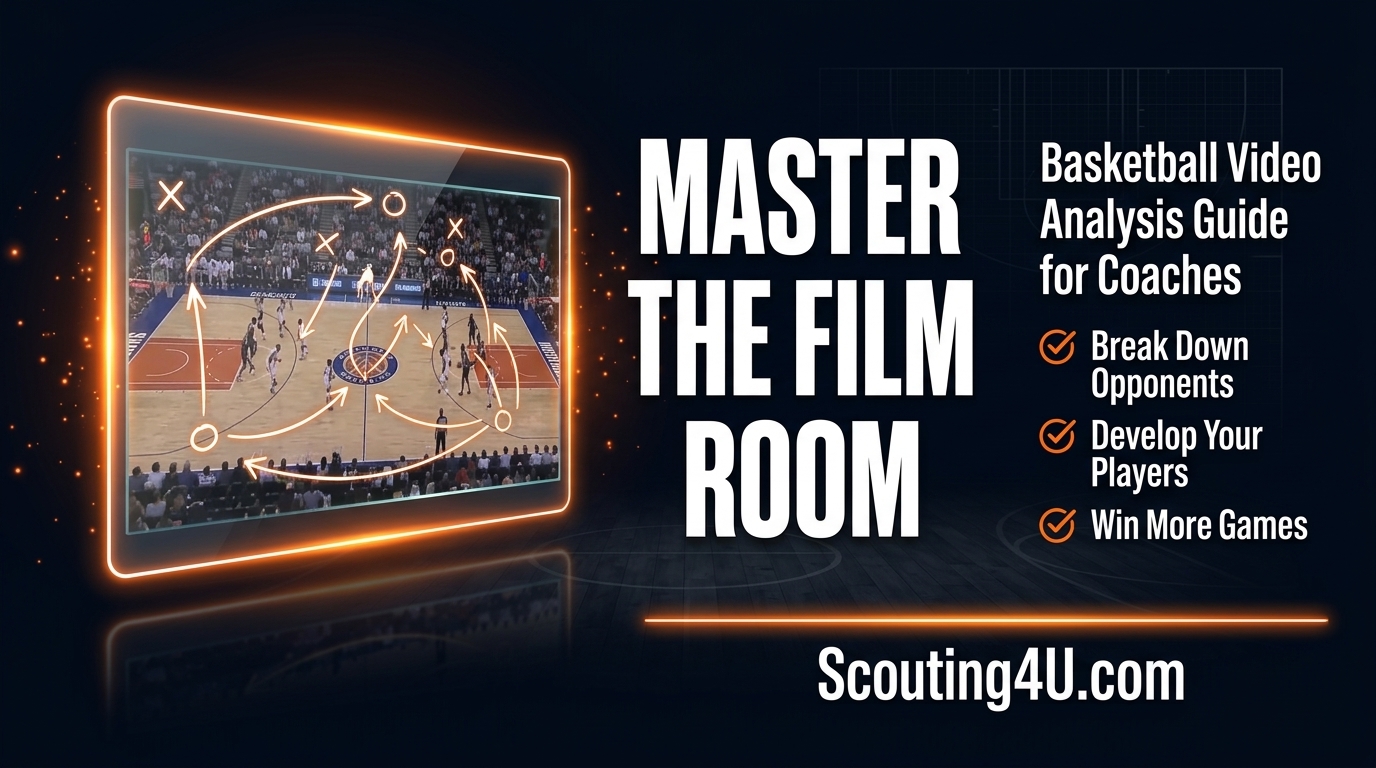
Mastering Basketball Video Analysis for Coaches
Key Takeaways
Basketball video analysis helps coaches evaluate players and teams more accurately.
Scouting4U offers advanced basketball video analysis tools built on EuroLeague experience.
Good basketball video analysis improves coaching decisions and game preparation.
Breaking down basketball video analysis reveals performance patterns that raw stats miss.
Daniel Gutt's EuroLeague background shapes how Scouting4U approaches basketball video analysis.
What Is Basketball Video Analysis?
Basketball video analysis is the process of reviewing game footage to evaluate player performance, team tactics, and opponent tendencies. Coaches at every level - from youth leagues to professional clubs - use basketball video analysis to make better decisions. It goes well beyond highlight reels. Every frame can tell you something: how a player moves without the ball, how a defense rotates, where spacing breaks down.
The demand for structured basketball video analysis has grown fast. Clubs that once relied purely on box scores now expect their coaches to back up lineup decisions with footage. That shift has made basketball video analysis a core coaching skill, not an optional extra.
Done well, basketball video analysis turns observation into evidence. A coach's instinct says a player struggles in pick-and-roll coverage. The video either confirms it or shows something more complicated. That distinction matters when you're preparing for a game or evaluating a player for recruitment. If you want to understand how basketball video analysis fits into broader scouting workflows, the guide on how coaches prepare scouting reports is worth reading alongside this article.
Why Basketball Video Analysis Changes How Coaches Work
Before video tools became accessible, coaches depended on live observation and handwritten notes. Memory is selective. Notes miss things. Basketball video analysis removes that problem. You can rewatch the same sequence ten times, slow it down, and tag it for later reference.
This changes preparation. Instead of describing a defensive scheme to players in abstract terms, you show them the clip. Instead of guessing why your offense stalled in the fourth quarter, you pull the footage and find out. Basketball video analysis makes game prep specific rather than general.
It also improves player development. When a player sees their own footage, feedback lands differently than verbal instruction. Basketball video analysis gives players a concrete view of their habits - both good and bad. That visual feedback accelerates improvement in ways that words alone rarely achieve.
For recruitment, basketball video analysis is now standard. Scouts reviewing players in different countries or leagues cannot attend every game in person. Video bridges that gap. A well-organized basketball video analysis library lets decision-makers evaluate players on their own schedule, with consistent criteria applied across the board. The article on remote basketball scouting covers how basketball video analysis has transformed that talent evaluation process in detail.
Basketball Video Analysis as a Core Coaching Skill
Five years ago, the question was whether to use basketball video analysis at all. Now it is which system to use and how to use it well. That shift matters because it means the bar has moved. Coaches who still treat footage review as optional are operating below the current standard at most competitive levels.
The central question in any serious staff conversation about preparation is no longer "who did we watch live?" It is "what does the basketball video analysis show?" That change in framing represents a different relationship with evidence - one where footage is the baseline, not the supplement.
Basketball video analysis also functions as a common language between coaching staff members. When a lead assistant and a position coach both watched the same tagged sequence, their conversation starts from the same place. That shared reference point cuts down on vague disagreements that eat up meeting time when preparation is based on individual memory rather than shared footage.
Basketball video analysis at the professional level is a craft. Developing the eye for what matters takes time. Good software speeds up the mechanical work, but the judgment still has to come from experience. That is why platforms built by people who have actually sat in coaching staff meetings tend to outperform those built purely from the outside.
Basketball Video Tagging: The Foundation of Organized Analysis
Raw footage is not useful on its own. You need structure. That is where tagging comes in within any basketball video analysis workflow. Tagging means labeling clips with categories - play types, defensive actions, shot locations, transition sequences - so you can retrieve them quickly.
Good basketball video analysis with consistent tagging turns hours of footage into a searchable database. Want to review every pick-and-roll your opponent ran in the last three games? A well-tagged system gives you that in seconds. Without tagging, you are scrubbing through footage manually, which defeats the purpose of having the video at all.
Scouting4U's basketball video analysis tools are designed around how coaches actually work. The tagging categories reflect real basketball situations rather than generic labels. That specificity matters. When a coach tags a possession as "DHO into side ball screen" rather than just "offense," the resulting database is actually useful for game preparation.
The time investment in tagging pays off fast. Teams that build consistent basketball video analysis habits find that their pre-game prep becomes much more efficient. You are not starting from scratch before each game - you are drawing on a growing archive of organized footage. For a deeper look at the mechanics of this process, the guide on basketball video tagging for efficient game film analysis covers the practical workflow in detail.
Choosing Basketball Video Analysis Software
Not all basketball video analysis software is the same. The right tool depends on what you need it to do. Some platforms focus on tagging and clip management. Others integrate statistical analysis alongside the video. Some are built for professional clubs with large analyst teams. Others are designed for individual coaches working alone.
A few things to look for when evaluating basketball video analysis options:
Tagging speed and flexibility - can you create custom categories that match your system?
Clip sharing - how easily can you send a sequence to a player or assistant?
Statistical integration - does the platform connect video to performance data?
Ease of use - will your staff actually use it, or will it sit unused because it is too complicated?
Scouting4U was built with these questions in mind. Daniel Gutt's years working in EuroLeague environments shaped the product. The platform reflects what analysts at a high level actually need from basketball video analysis tools - not what sounds impressive in a feature list. You can explore the full range of capabilities on the Scouting4U features page.
Basketball Game Film Breakdown: How to Structure Your Review
A basketball video analysis session is only as useful as the framework you bring to it. Watching footage without a clear purpose wastes time. Start with specific questions before you open a single clip.
For opponent scouting, your questions might be: How do they attack pick-and-roll? What are their preferred actions in late-clock situations? Who initiates offense and what does that player do when pressured? Each question gives you a filter for the footage. You are not watching the whole game - you are hunting for specific information.
For self-scouting, the questions shift. Where did our spacing break down? How often did we generate second-chance opportunities? Were our defensive rotations consistent? Basketball video analysis for self-improvement requires honesty. Coaches sometimes avoid reviewing their own team's mistakes in detail. That avoidance is expensive.
A structured basketball video analysis typically works in phases. First pass: watch the relevant sequences at full speed to get a sense of the pattern. Second pass: slow down and tag. Third pass: build the presentation or report from your tagged clips. This approach keeps basketball video analysis efficient without cutting corners on depth.
Connecting Basketball Video Analysis to Statistics
Basketball video analysis and statistical analysis work best together. Numbers without context can mislead. A player with a low assist-to-turnover ratio might look like a liability until you see that most of their turnovers came in specific high-pressure situations the team put them in unnecessarily. The video explains the number.
The same logic runs in the other direction. Video without statistics can mislead too. A sequence that looks chaotic might actually represent the team's best offensive process - the shot just did not fall. Metrics like offensive rating, true shooting percentage, and transition frequency add context to what the footage shows.
Scouting4U integrates both layers. Coaches can move between statistical summaries and corresponding footage without switching platforms. That integration is where basketball video analysis becomes genuinely useful rather than just time-consuming. For context on which statistics matter most in this kind of work, the breakdown of advanced basketball statistics and must-know metrics is a solid reference.
Basketball Video Analysis for Player Development
Basketball video analysis is one of the most direct tools available for player development. Verbal feedback from coaches has limits. Players filter it through their own assumptions and memory. When a player watches basketball video analysis footage of their own tendencies, that filtering disappears.
Showing a player a compiled sequence of the same defensive mistake repeated across five games is not the same as telling them about it once after practice. It demonstrates a pattern. That distinction changes how the player receives the feedback and how quickly they adjust.
The same approach works for team tendencies. A review of every possession where your offense stalled before the shot clock expired forces a real conversation about habits and decision-making. Basketball video analysis used this way is direct, which is exactly what good coaching sometimes requires. Players generally respond better to footage than to abstract criticism because the evidence is right in front of them.
Basketball video analysis also works for reinforcing what players do well. Showing a defender a sequence of five possessions where their positioning was correct - before their next game against a similar opponent - builds confidence grounded in actual evidence rather than general encouragement.
Play-by-Play Analysis and Basketball Video
Play-by-play analysis maps out the sequence of every possession in a game. When combined with basketball video analysis, it becomes a powerful diagnostic tool. You can identify exactly when momentum shifted, which lineup combination was on the floor during a third-quarter run, or how many possessions ended without a shot attempt.
This level of detail supports rotation decisions. If your second unit consistently gives up scoring runs in a specific game segment, basketball video analysis tied to play-by-play data shows you exactly when and how that happens. You stop guessing about lineup construction and start making decisions based on what the footage and numbers together tell you.
Possession-by-possession basketball video analysis is particularly useful before games against opponents with unusual tactical tendencies. Some teams run very few set plays and rely on read-and-react offense. Others are highly scripted. The play-by-play breakdown combined with footage tells you which one you are preparing for - and that changes your defensive game plan entirely.
Time Management in Basketball Video Analysis
The biggest complaint coaches have about basketball video analysis is time. Breaking down game film takes hours. Tagging takes time. Building presentations for players takes more time. For coaching staffs without dedicated analysts, this is a real constraint.
The answer is not to do less basketball video analysis. It is to build efficient habits. Start with the highest-priority questions before the next opponent. Tag as you go rather than re-watching footage after the fact. Use platform tools that speed up clip retrieval. Standardize your presentation format so you are not rebuilding it from scratch each time.
Scouting4U's basketball video analysis tools are designed to reduce the time cost without reducing analytical depth. The 30-minute preparation framework that some coaches use as a minimum baseline is achievable with the right system in place. If time efficiency in pre-game analysis interests you, the practical guide on AI-assisted scouting tips for faster game prep covers specific strategies.
Getting Started with Basketball Video Analysis
If your program is new to structured basketball video analysis, start simple. Pick one specific question you want the footage to answer before your next game. Tag clips related to that question. Build a short presentation around what you find. Show it to your players and see how they respond.
That single cycle - question, footage, clips, presentation, discussion - is the foundation of everything else in basketball video analysis. Once it becomes routine, you expand. More questions, more tagging categories, deeper statistical integration. The complexity grows with your capacity to use it.
Scouting4U is built to support that progression. Whether you are running basketball video analysis for a semi-professional club with a small staff or a professional team with multiple analysts, the platform scales. Check the subscription plans to find the option that fits your setup.
One practical tip: designate a specific time in your weekly schedule for basketball video analysis rather than treating it as something you do when time allows. Coaches who block time for it consistently get more out of the process than those who fit it in around everything else. Even 90 minutes twice a week, done with a clear framework, produces better preparation than four hours of unfocused footage-watching the night before a game.
Conclusion
Basketball video analysis is not a luxury for elite programs. It is how serious coaching is done at every competitive level. The gap between teams that use basketball video analysis systematically and those that rely on memory and intuition is measurable - in preparation quality, player development, and game-day decisions.
Scouting4U gives coaches the tools to do basketball video analysis properly without requiring a full-time analyst on staff. The tagging system, statistical integration, and clip management are built around how real coaching workflows operate. Daniel Gutt's EuroLeague experience is embedded in how the platform works, not just in the marketing around it.
If basketball video analysis is already part of your process, Scouting4U helps you do it faster and more consistently. If you are just starting out, it gives you a structure that scales as your program develops. Either way, the starting point is the same: commit to making basketball video analysis a regular part of how your staff prepares, not an occasional add-on.
Frequently Asked Questions
What does basketball video analysis actually involve?
Basketball video analysis involves reviewing game footage to evaluate player behavior, team tactics, and opponent patterns. It includes watching clips at different speeds, tagging sequences by category, connecting video to statistical data, and building presentations for players or staff. The goal is to turn footage into specific, actionable information rather than general impressions.
How does basketball video analysis tagging work?
Basketball video analysis tagging means labeling individual clips with descriptive categories - play types, defensive actions, shot zones, specific matchups - so you can search and retrieve them quickly. A well-tagged basketball video analysis library lets you pull every pick-and-roll sequence from the last three games in seconds rather than rewatching hours of footage manually.
Can basketball video analysis help with player recruitment?
Yes. Basketball video analysis is now standard in recruitment, particularly for evaluating players in different leagues or countries where in-person attendance is not practical. Video allows scouts to apply consistent evaluation criteria across multiple players, build detailed profiles, and share footage-backed assessments with decision-makers regardless of location.
How much time does basketball video analysis take per game?
It depends on the depth of analysis and the tools you use. A full opponent breakdown can take several hours. A focused review of specific tendencies - using a well-organized basketball video analysis tagging system - can be done in 30 to 60 minutes. Platforms like Scouting4U reduce the time cost significantly compared to manual clip work.
What statistics work best alongside basketball video analysis?
Metrics that describe efficiency and process tend to pair well with footage in basketball video analysis - offensive and defensive rating, true shooting percentage, transition frequency, and second-chance point rates. These numbers give context to what you see on screen. A player's defensive rating looks different after you watch 10 possessions of their coverage. The video and the number together tell you something neither one can alone.
Enjoyed this article? Share it with others!
Founder & Lead Scout, Scouting4U
2x EuroLeague champion with 30+ years in professional basketball. Daniel won EuroLeague titles with Maccabi Tel Aviv, helped build the staff behind the 2007 European Championship, and has delivered 100+ professional scouting reports across 50+ leagues. If it happened in a European basketball front office, he was probably in the room. He founded Scouting4U in 2010 to bring championship-level scouting intelligence to every club.
No reviews yet. Be the first to share your experience!
Related Articles

Basketball Analysis: Elevate Game Insights with Video
Key TakeawaysSystematic video breakdown improves decision-making at every level of the game.Video tagging software makes...
True Shooting Percentage Basketball: Calculation & Insights
Key TakeawaysTrue shooting percentage basketball offers a comprehensive efficiency metric that goes beyond simple field ...
How Data Analytics Transforms Basketball Recruitment
Key TakeawaysData analytics basketball recruitment improves how scouts evaluate players with objective, repeatable metri...